Selected work
mosaico-chat — a portable RAG engine, no admin UI required
A serverless RAG system that powers AI features across two Mosaico products — managed entirely by an agent, not a dashboard, and ready to plug into any legacy SaaS.
Role
Product & architecture lead
Timeline
Mid-2025 → live · 2 iterations
Years
2025 – 2026
Status
In production · 4 agents · 2 products
The origin
Two Mosaico products — Teams and Network — both needed deep AI. Building the RAG layer twice meant doubled cost, doubled maintenance, and no path to selling the engine on its own. mosaico-chat became the shared spine: one engine, multiple agents, multiple products.
The problem
Off-the-shelf RAG was either too expensive to host or required an admin dashboard the size of a separate product. Custom Bedrock builds were out of reach for legacy SaaS teams. The gap: a portable engine that an agent could configure — no UI to maintain, no infra to run.
The hypothesis
“If an agent can administer the RAG system, the admin UI disappears. What’s left is a public API contract — and that contract is the product.”
Two iterations, one cost curve
Why v2 was only possible in mid-2026
Iteration 01 · mid-2025
Python/JS · EC2 · Tesla GPU
Cost model
$500/mo fixed
Custom infra was the only viable path: S3 Vectors didn’t exist yet, OpenSearch cost more than a Tesla-equipped EC2. Right call for the moment.
Iteration 02 · 2026 · current
Lambda · Bedrock · S3 Vectors
Cost model
~$0.04 per query · pay-per-use
S3 Vectors made fixed-cost infra obsolete. Lambda removed the always-on bill. Bedrock provided model access without managing weights. Same capability, fraction of the cost.
Three design decisions
The architectural choices that defined the product
01
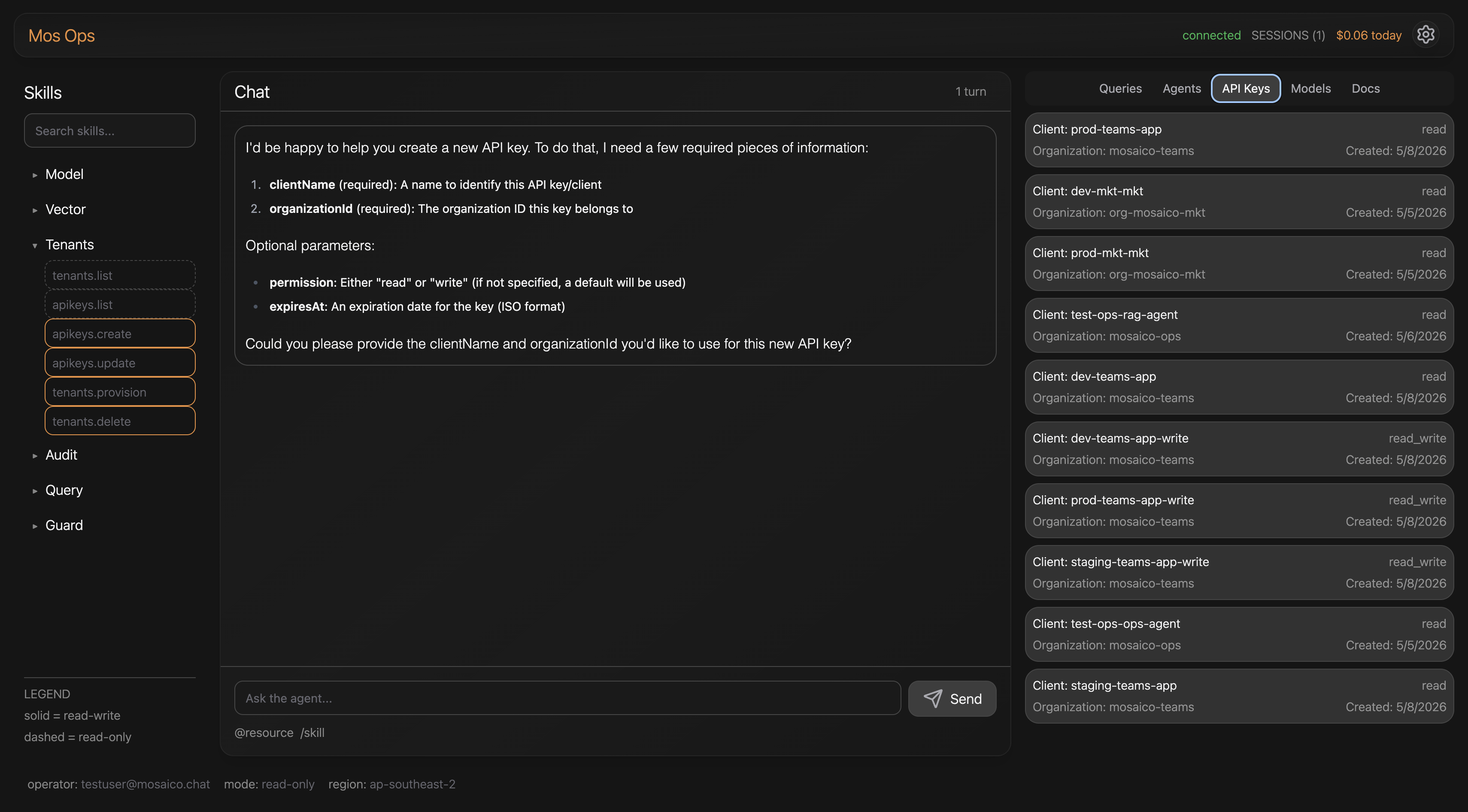
Pipeline A — the agent is the admin UI
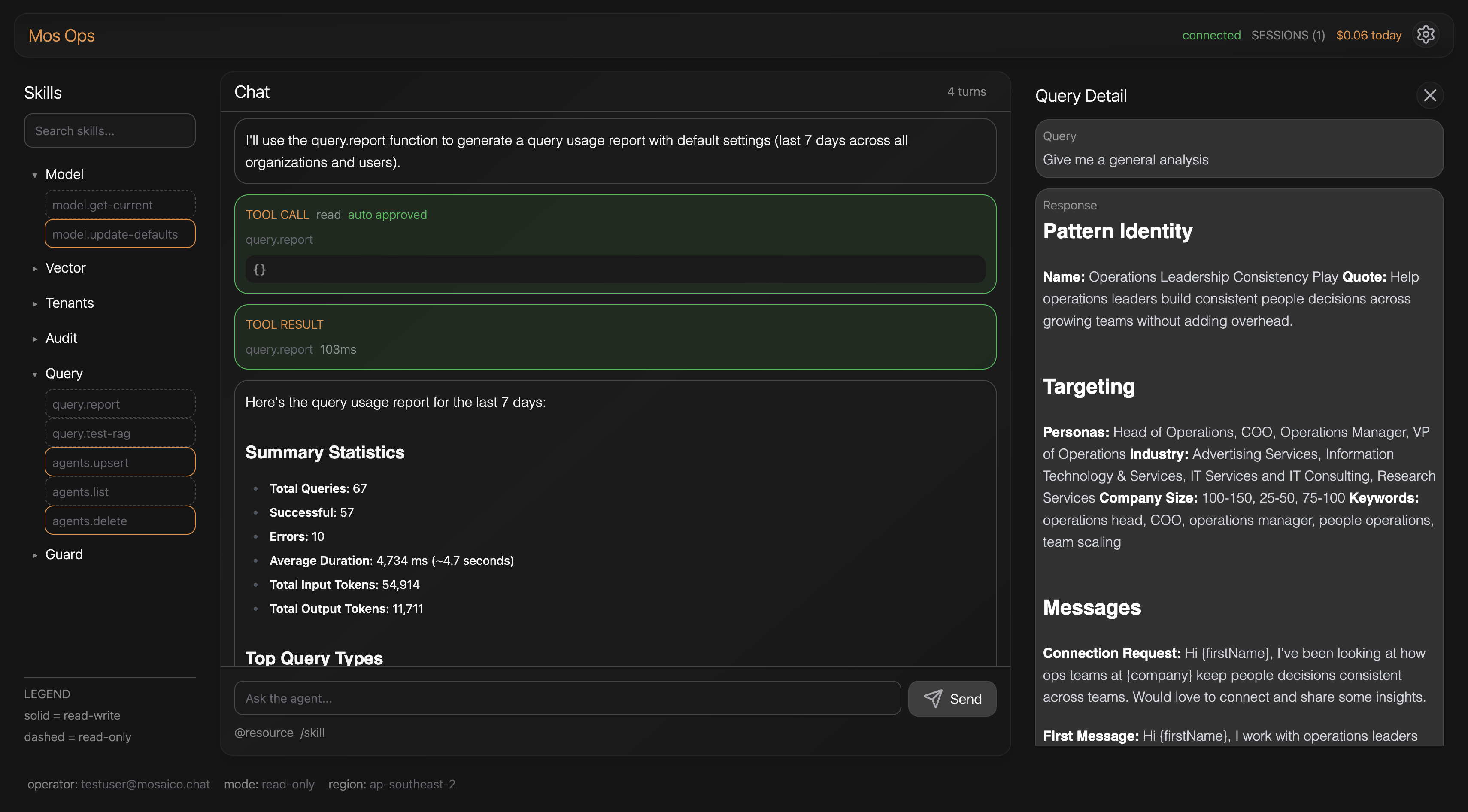
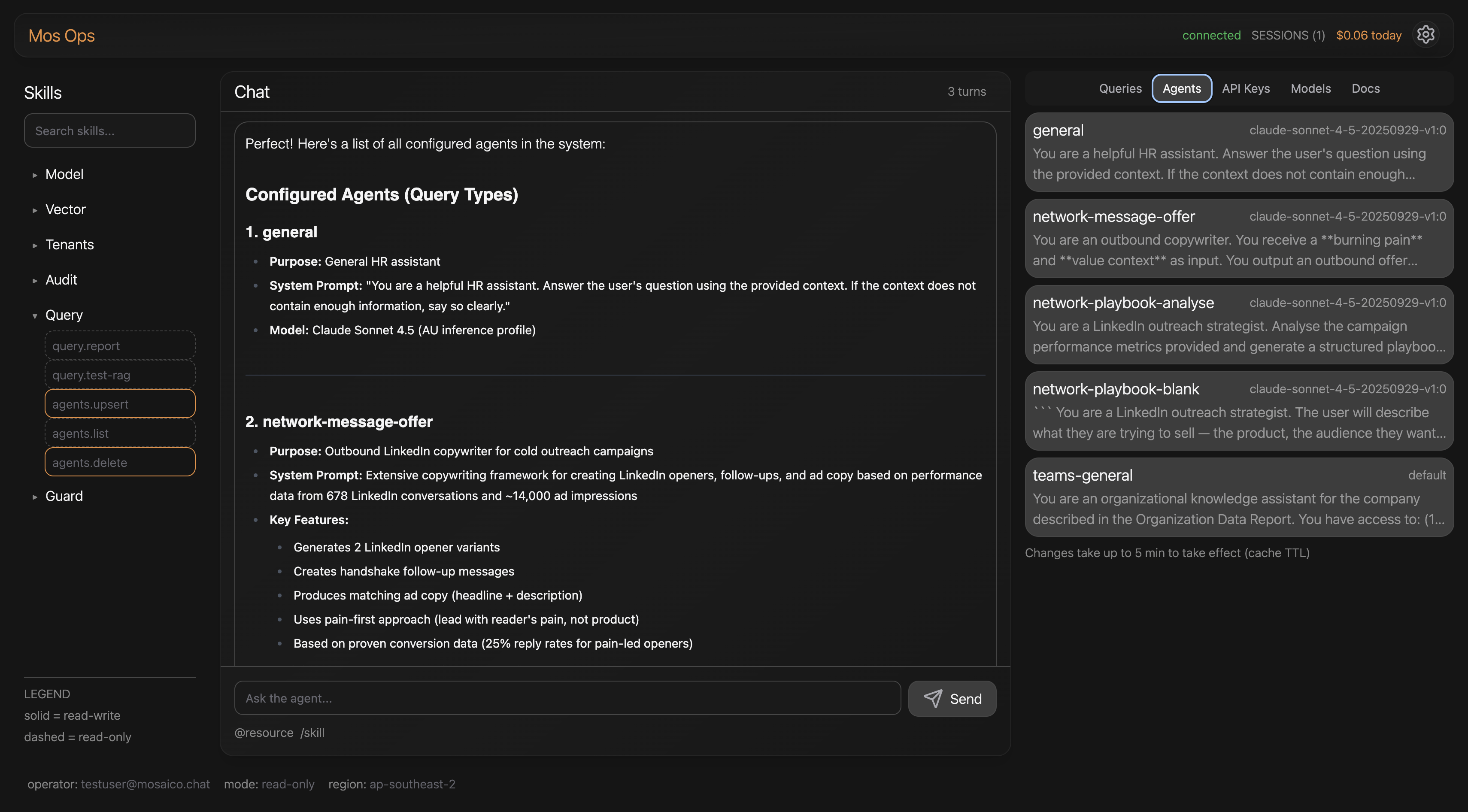
Pipeline A is an agent that manages Pipeline B's configuration — API keys, system prompts, query reports, parameters — by talking directly to Dynamo and Bedrock. No admin dashboard. No dozens of config screens. Configuration becomes a conversation.
02
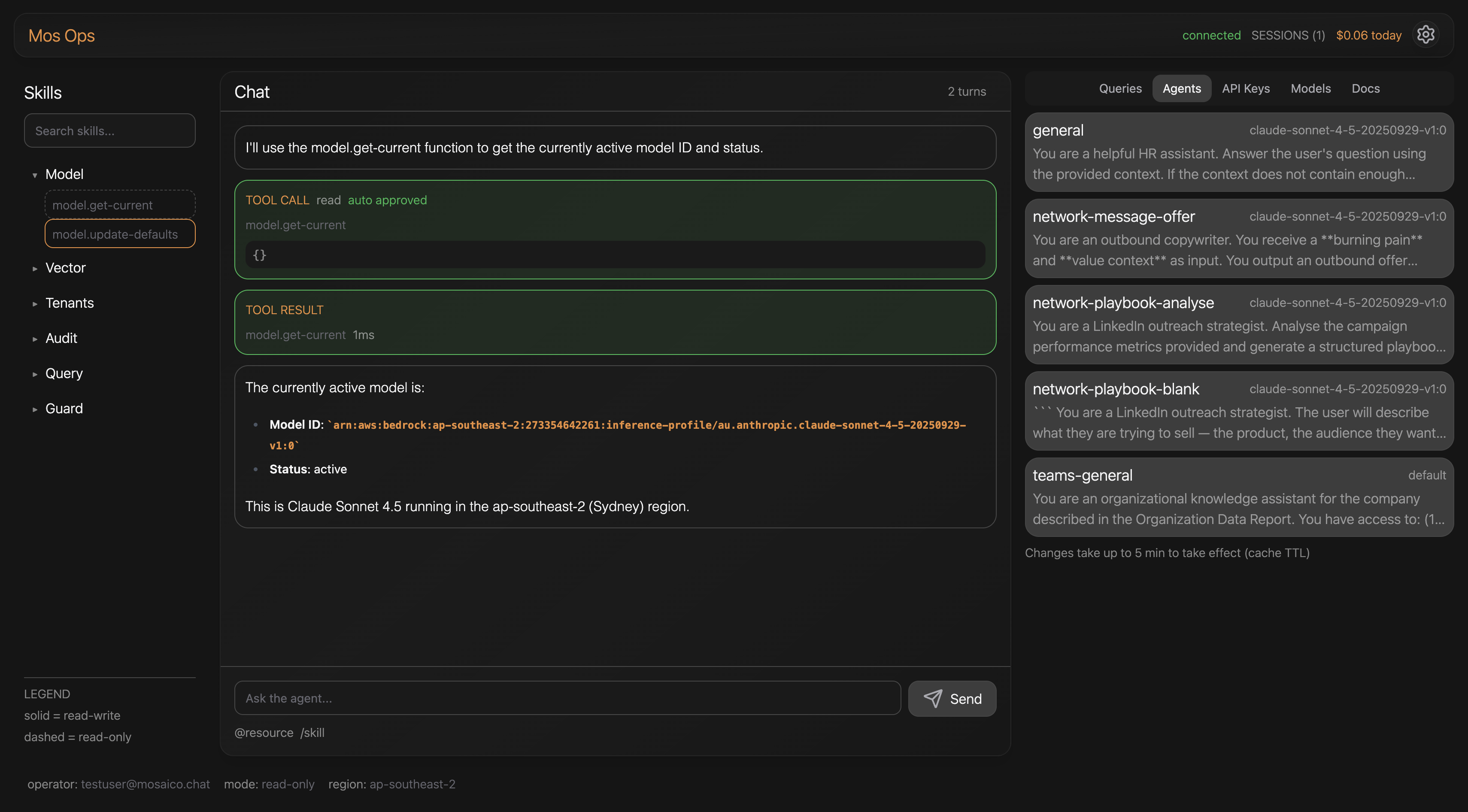
Pipeline B — public API contract, multi-agent per tenant
One contract: NL or data in, NL or data out. Multiple specialised agents per tenant — Teams runs 1, Network runs 3, each scoped to specific contexts and output shapes. The product is the contract; the engine stays out of the customer's stack. Full pipeline observability built in.
03
Serverless on Bedrock + S3 Vectors — fixed cost out, pay-per-use in
V1 ran on EC2 + Tesla GPU at $500/mo fixed because S3 Vectors didn't exist and OpenSearch was more expensive. When S3 Vectors landed in mid-2026, the whole stack moved to Lambda + Bedrock — no idle cost, no model hosting, no infra team. ~$0.04 per query at production load.
Trade-off rejected
Rejected
Per-product RAG + admin dashboard
The default path: build RAG twice (once for Teams, once for Network), each with its own admin UI, each maintained separately. mosaico-chat refused — one engine, agent-administered, public contract. That choice is also what makes it sellable as a standalone product to legacy SaaS.
Outcomes
Metric 01
$500 → $0.04
monthly fixed → per-query · v1 → v2
Metric 02
~4.6s
end-to-end query · Sonnet 4.5 / Bedrock
Metric 03
4 agents
Teams (1) + Network (3) · expanding
Metric 04
2 products
live in production · one shared engine
Qualitative outcome · how it’s used
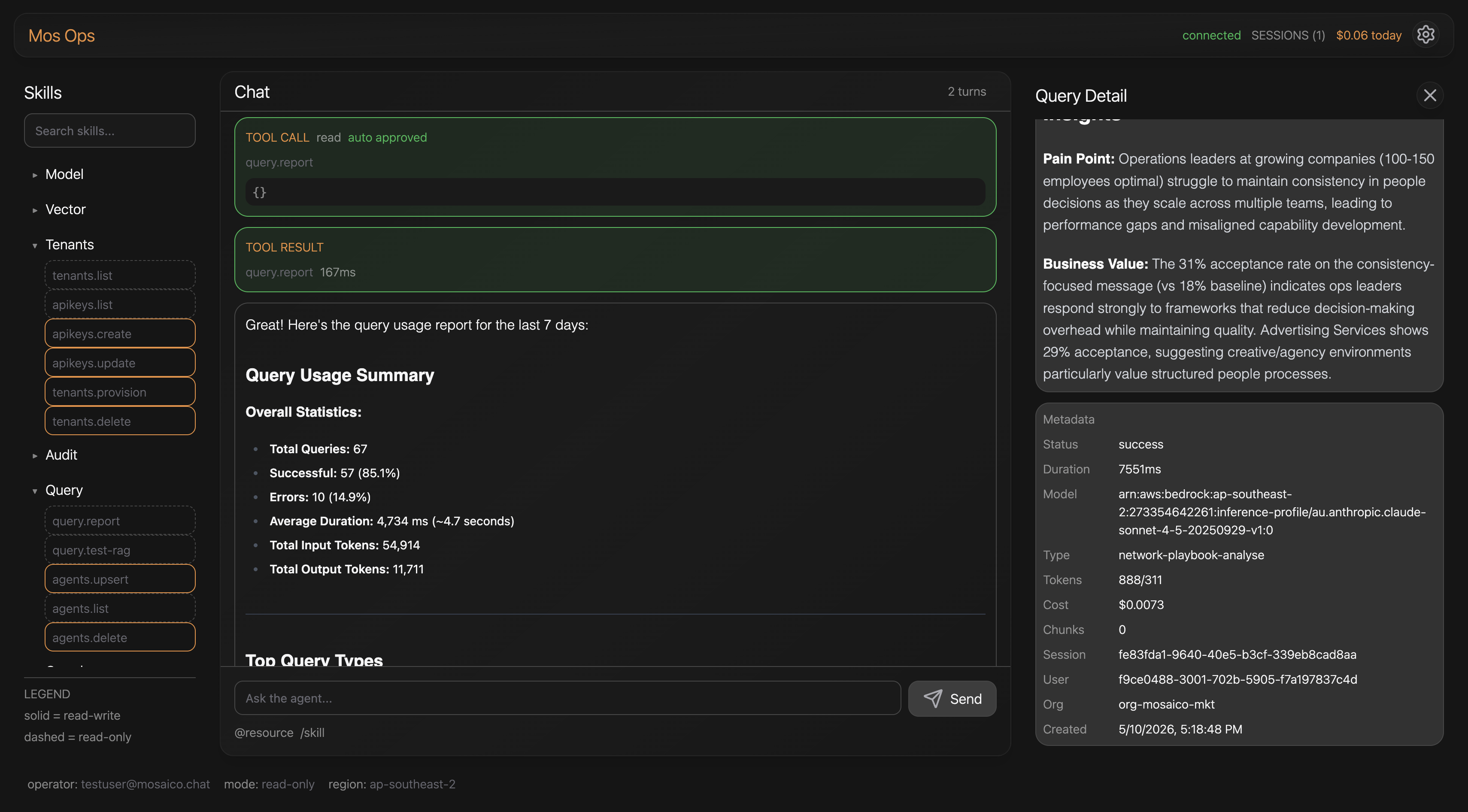
Teams: org compliance + capability queries against live process data. Network: SDR campaign generation + post-launch performance reports. Same engine, different agent contracts.
Qualitative outcome · observability
Every query is timed end-to-end across 7 stages with hallucination risk and search score recorded — production debugging is a dashboard, not a forensic exercise.
What I learned
The right architecture is the one the cloud catalogue allows — and the catalogue moves. V1 was the right call in 2025; six months later, S3 Vectors made V1 obsolete. The lesson: build for the contract, not the infra. When the substrate shifts, only the implementation has to move.
What’s next
A stack-agnostic SDK so legacy SaaS teams can plug mosaico-chat in without building chat UIs or DB-snapshot pipelines themselves. Expand the agent library on Teams, and start onboarding the first external customer onto the engine as a standalone product.