Selected work
Mosaico Teams App — what AI-native architecture lets two people ship
An HR & ops platform where processes, positions and reports are AI-managed — built in 10 months by 1 FTE + 1 part-time, after a month-6 pivot to an AI-native stack.
Role
Product & design lead · architecture decisions
Timeline
10 months · build → pilot live
Years
2025 – 2026
Status
In pilot · selling since Feb 2026
The origin
Ten years at Jemini taught two hard lessons. Every people-process — onboarding, performance, training — was hardcoded. New module: 6 months, 10 devs. To absorb every customer’s edge case, modules became bloated and expensive to support. Reports were rigid: pre-built dashboards that rarely matched what the user actually wanted. Mosaico Teams App was built to fix all three.
The reframe
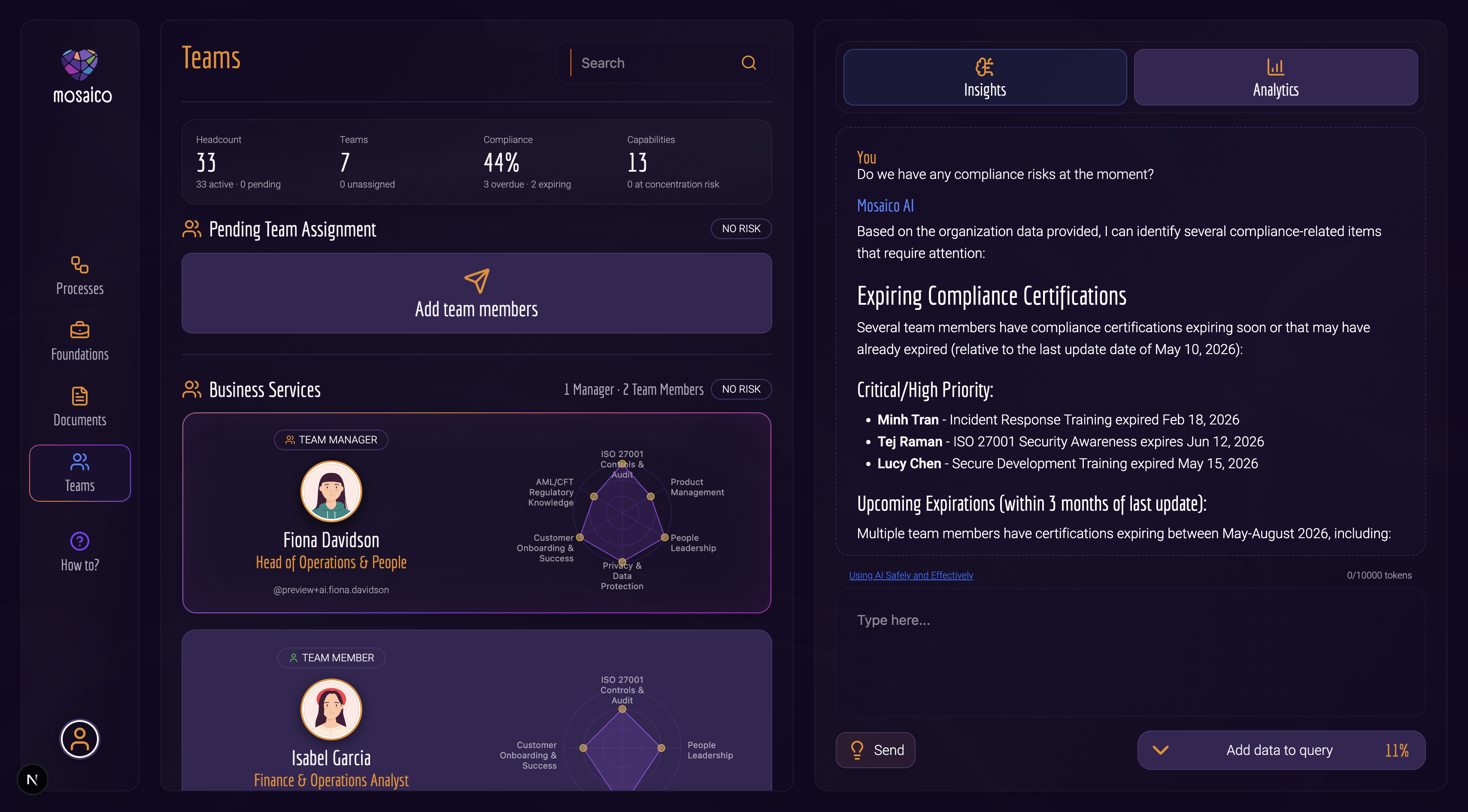
Don’t hardcode processes — let AI manage them. Natural language becomes positions, processes, capabilities, compliance. One-click install for SMBs, full customisation down to the field for enterprise. Reports stop being dashboards and start being conversations against live data via RAG.
The hypothesis
“Hardcoded software is the bottleneck. If processes, positions and reports can all be AI-managed, two people can ship what used to take ten — and the product can be both SMB-ready and enterprise-deep.”
The pivot — month 6
The moment the architecture had to change
Before · months 1–6
Traditional stack · 10% AI-assisted
Trajectory said 24 months to ship the full feature set. Mixing human and AI coding without structured agents created anti-patterns. Reliability suffered.
After · months 7–10
AI-native stack · 99% AI-written
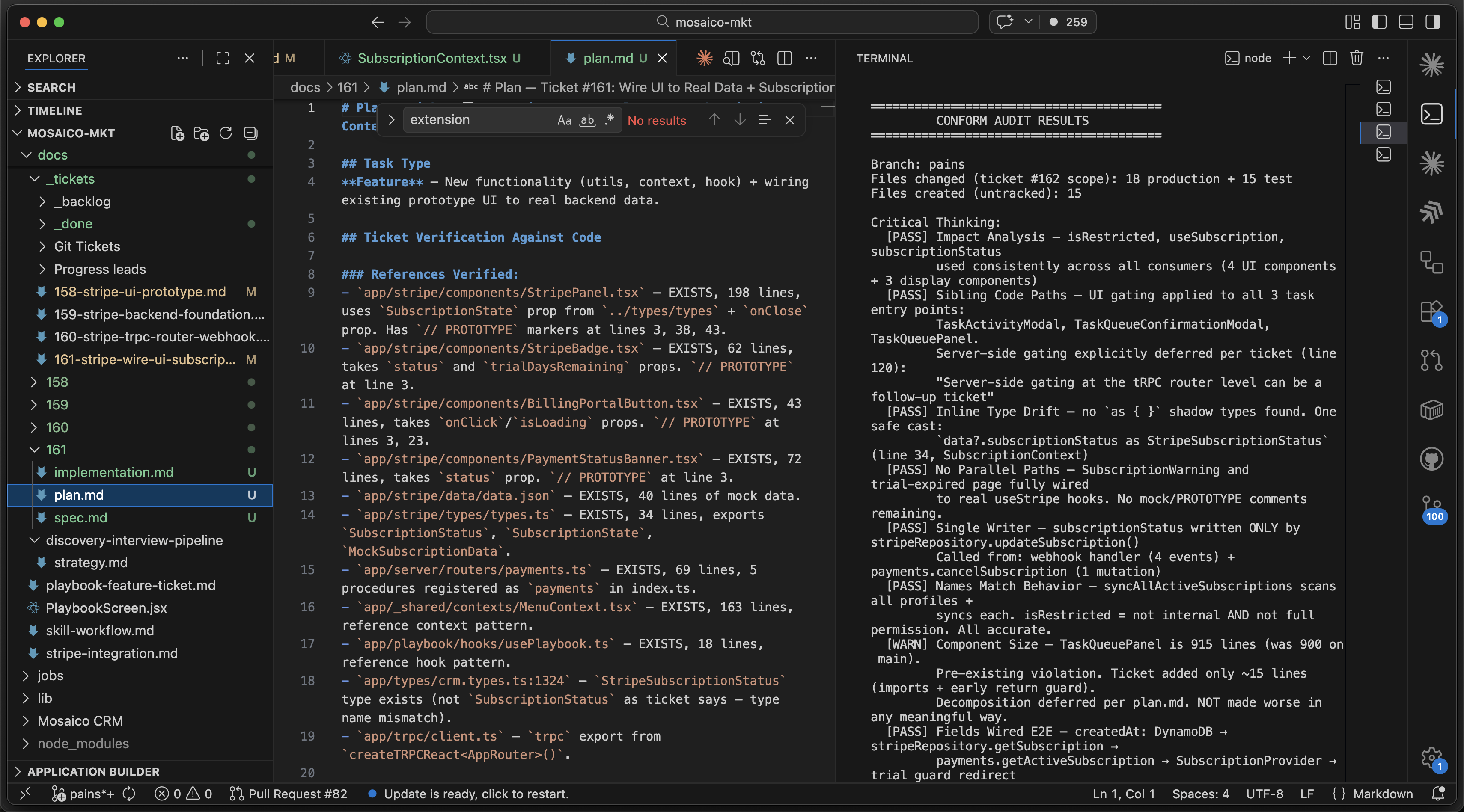
Refactored architecture for AI. Removed AWS abstractions without code/CLI exposure. Adopted a stack the AI knew well. Specialised agents own design, develop, deploy. Humans review and improve agents.
Two signals at once: the feature set wouldn’t land in 12 months, and the human-AI hybrid was generating anti-patterns faster than humans could fix them.
Three design decisions
What made the product feasible
01
AI-orchestrated design → develop → deploy pipeline
Specialised agents own each stage. Humans review code and improve agents to stop error repetition — they don't write code. Architecture chosen for AI familiarity, not human preference. The result: 99% AI-written code, fewer anti-patterns, no instability from human-AI mixing.
02
Processes & positions as AI-installable units, not hardcoded modules
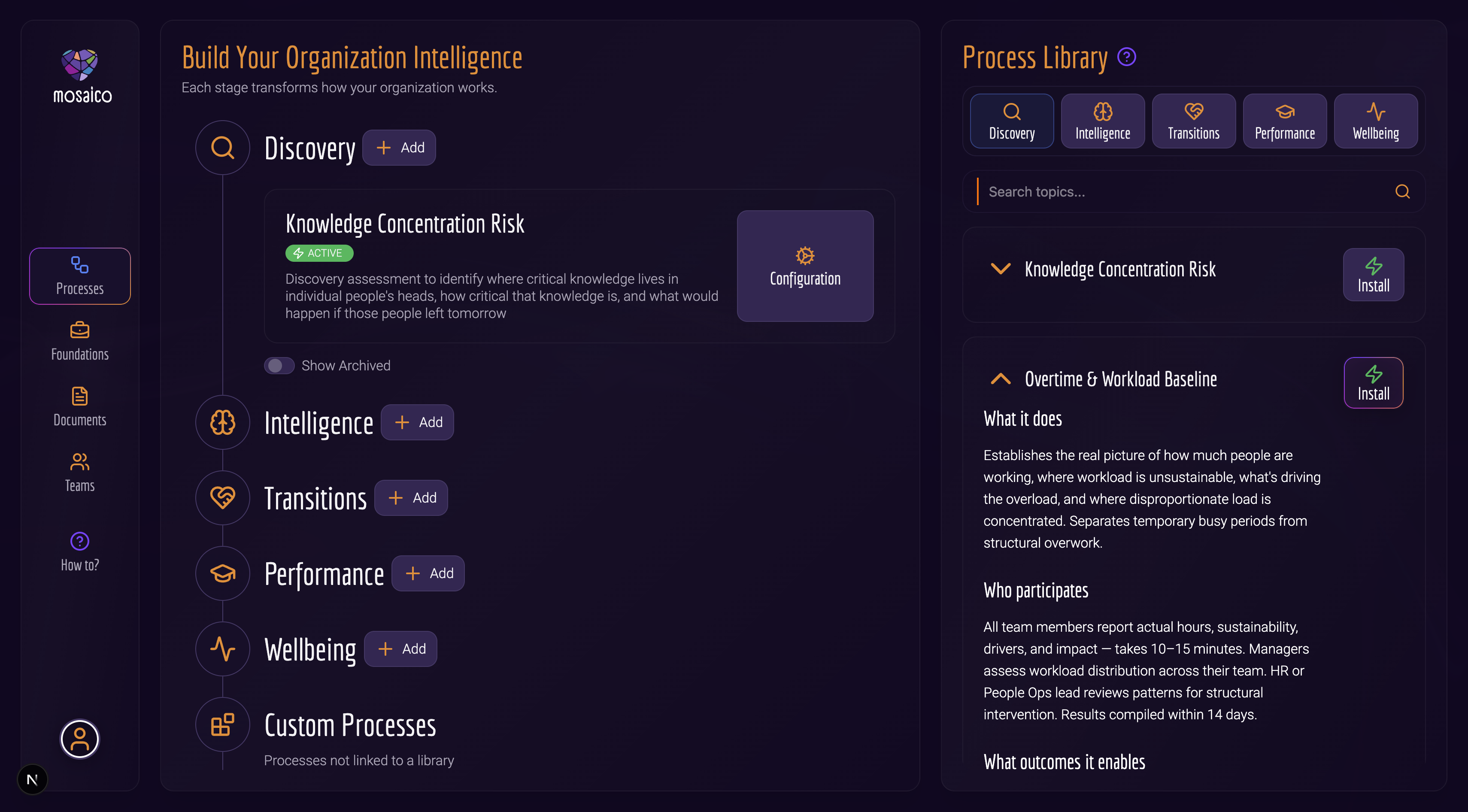
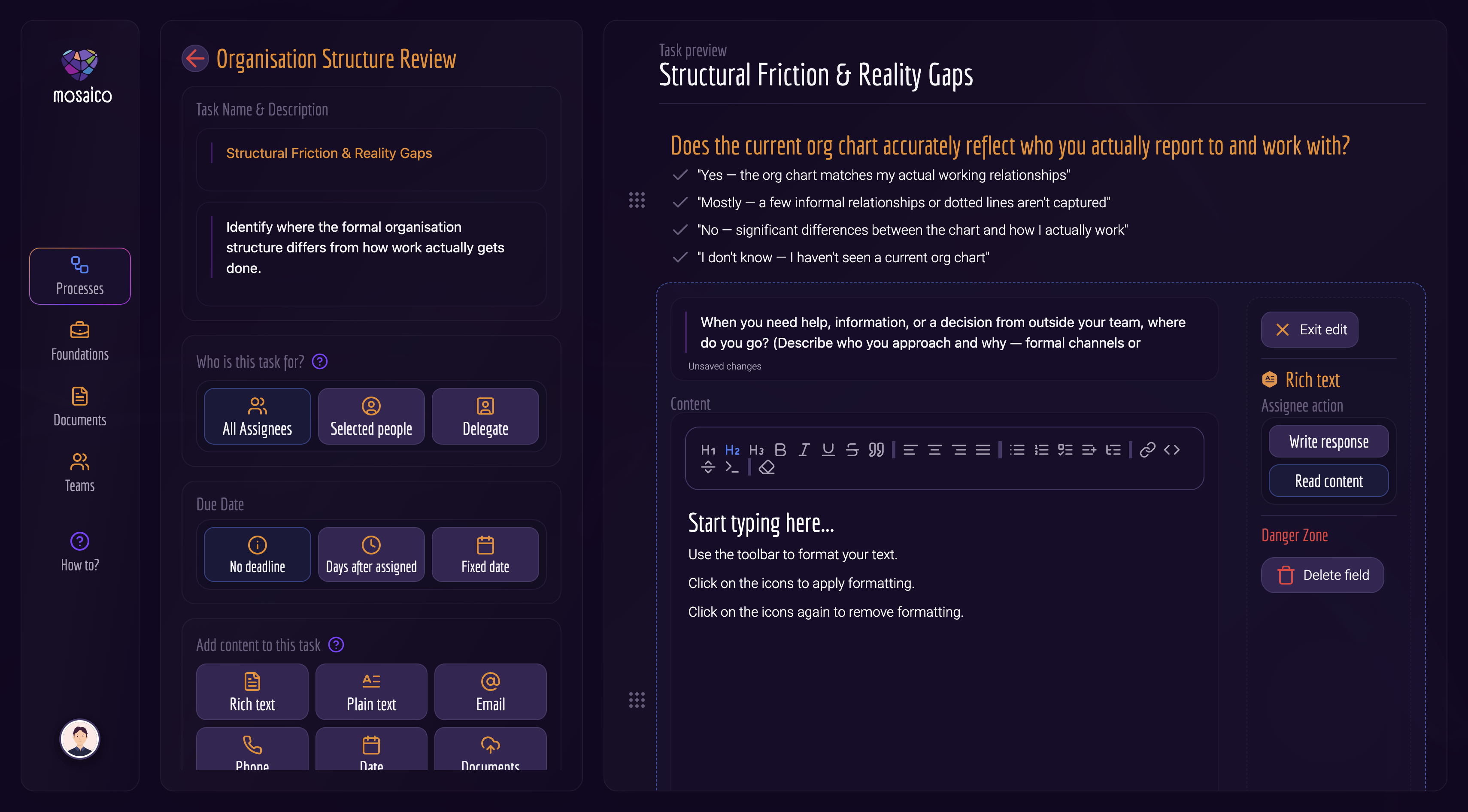
Natural language becomes processes, positions, capabilities and compliance records. Pre-built libraries cover 5 industries × 3 sizes (SMB / mid / enterprise) — one-click install. Every process drills down to tasks → fields, with 10 field types. SMB-ready out of the box, enterprise-customisable to the field.
03
RAG over live data — reports as conversations, not dashboards
All process, progress, position, capability and compliance data is exposed to a RAG layer. Users ask in plain language; the LLM produces the report in seconds. No more building a dashboard for every question, no more digging through pre-built views. Build cost drops, user friction drops, and the answer is exact.
Trade-off rejected
Rejected
Hardcoded modules + pre-built dashboards
The Jemini path: every process is a module, every report is a dashboard, every customer edge case bloats both. 6 months × 10 devs per module. Mosaico refused to repeat it. AI-managed records and RAG-driven reports collapse the cost curve and remove the bloat.
Outcomes
Metric 01
10 mo
build · 1 FTE + 1 part-time
Metric 02
99%
code AI-written · post-pivot
Metric 03
10k / 200
unit tests · E2E scenarios · ~80% cov
Metric 04
months → sec
process install time · vs Jemini era
Qualitative outcome · pilot
Selling since Feb 2026. First pilot customer with ~10 users on the platform. Library now covers 5 industries × 3 business sizes for one-click install.
Qualitative outcome · reliability
Zero crashes, no production bugs. AI scans the codebase for any reported issue in seconds — debugging is no longer a human bottleneck.
What I learned
AI is the ultimate augmentation when you know how to use it — it takes an idea to production code fast and lets you test what works at a fraction of the old cost. The win isn’t speed alone. It’s the cost of being wrong dropping low enough that experimentation becomes the strategy, not the exception.
What’s next
Expand the pilot to more customers, deepen the process library across more industries and sizes, and push the AI agents further into customer-facing surfaces — onboarding, configuration, support — where each interaction further trains the platform.